Solar system types

Choose the Right Solar System

Use this guide to understand On-Grid, Off-Grid and Hybrid solar systems before selecting the best fit for your home or business.

Important Note

For any type of Solar System whether On-Grid/Off-Grid/Hybrid the panels used are same. The difference only lies in their inverter types.

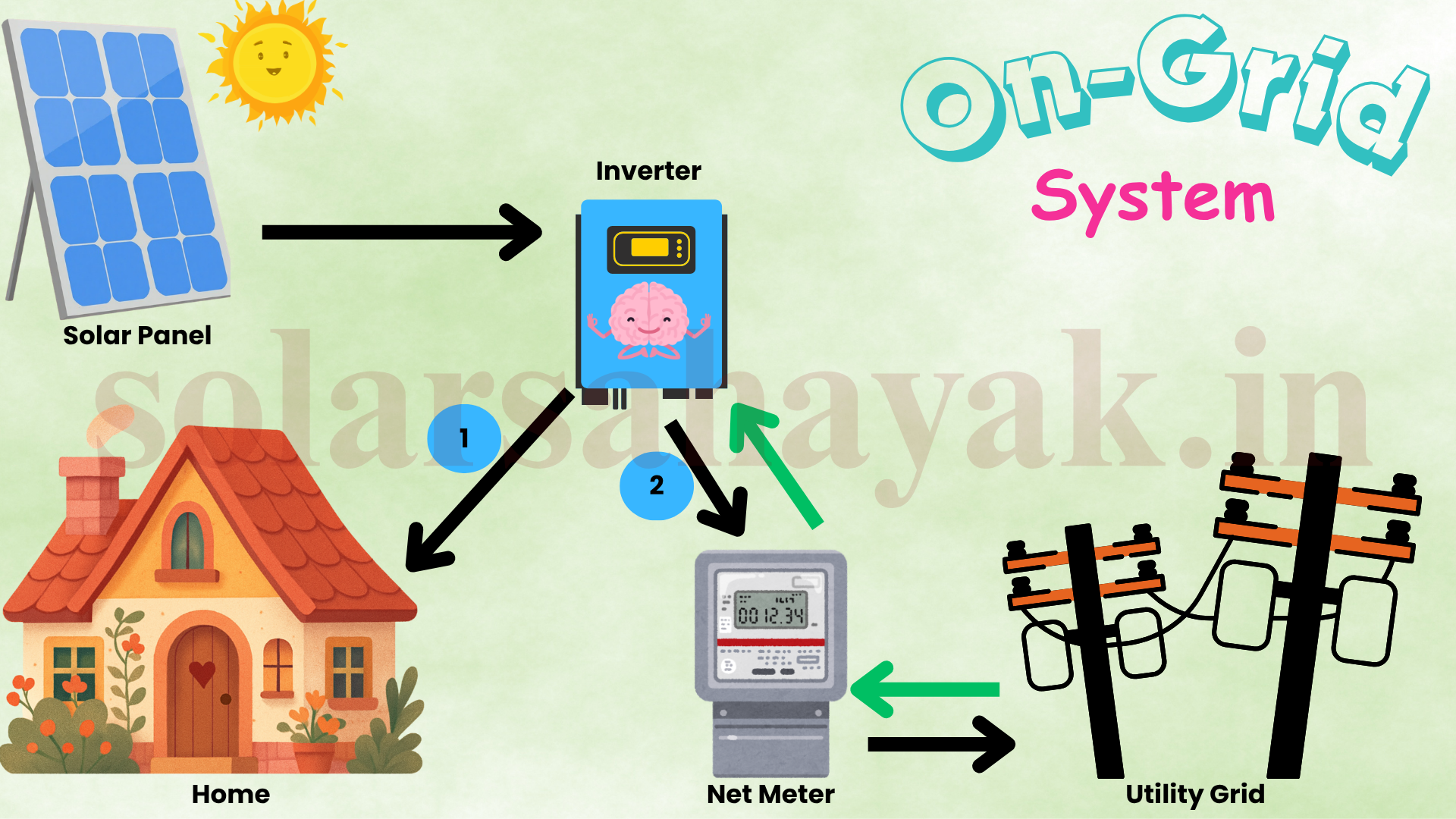
Uploaded On-Grid solar system diagram

On-Grid Solar

On-Grid Solar

Note: For any type of Solar System whether On-Grid/Off-Grid/Hybrid the panels used are same. The difference only lies in their inverter types.

What is an On-Grid Inverter?

An On-Grid Inverter (also called Grid-Tie Inverter) is like a smart translator in your solar power system.

Solar panels produce DC electricity (Direct Current) — like a steady stream of power in one direction.

Your home appliances, lights, fans, AC, and the electricity grid all use AC electricity (Alternating Current) — power that flips direction many times per second.

The On-Grid Inverter’s main job is to convert the DC power coming from solar panels into usable AC power that matches the quality and timing of your home electricity and the government grid (UPPCL/PuVVNL in Uttar Pradesh).

Simple Working Principle (Step by Step)

Here’s how an On-Grid Inverter works in easy language:

  1. Solar Panels Generate DC Power Sunlight hits the panels → they produce DC electricity.
  2. DC Power Goes to the Inverter The inverter receives this variable DC power.
  3. Conversion from DC to AC Inside the inverter, electronic switches (like very fast on-off buttons) flip the direction of electricity rapidly. This creates Alternating Current (AC) that looks like a smooth wave (sine wave), exactly like the power supplied by the electricity company.
  4. Synchronization with the Grid The inverter constantly checks the grid’s voltage, frequency, and phase. It adjusts its own output to perfectly match the grid (this is called synchronization). Only when it matches perfectly does it start feeding power.

Priority of Power Usage

  • First → Powers your home loads (lights, fans, machines etc.).
  • Extra power → Automatically exported (sent) to the government grid.
  • You get credit for this exported power through Net Metering.

Safety Feature (Anti-Islanding)

If the grid goes off (power cut), the on-grid inverter immediately stops producing power. This is a safety requirement so that electricity does not flow back into the dead grid and endanger linemen.

Important Limitations:

  • It cannot work without the grid. During power cuts, your solar system shuts down even if the sun is shining brightly.
  • No battery backup (unless you add a hybrid inverter).
  • Best suited for areas with very few or short power cuts.
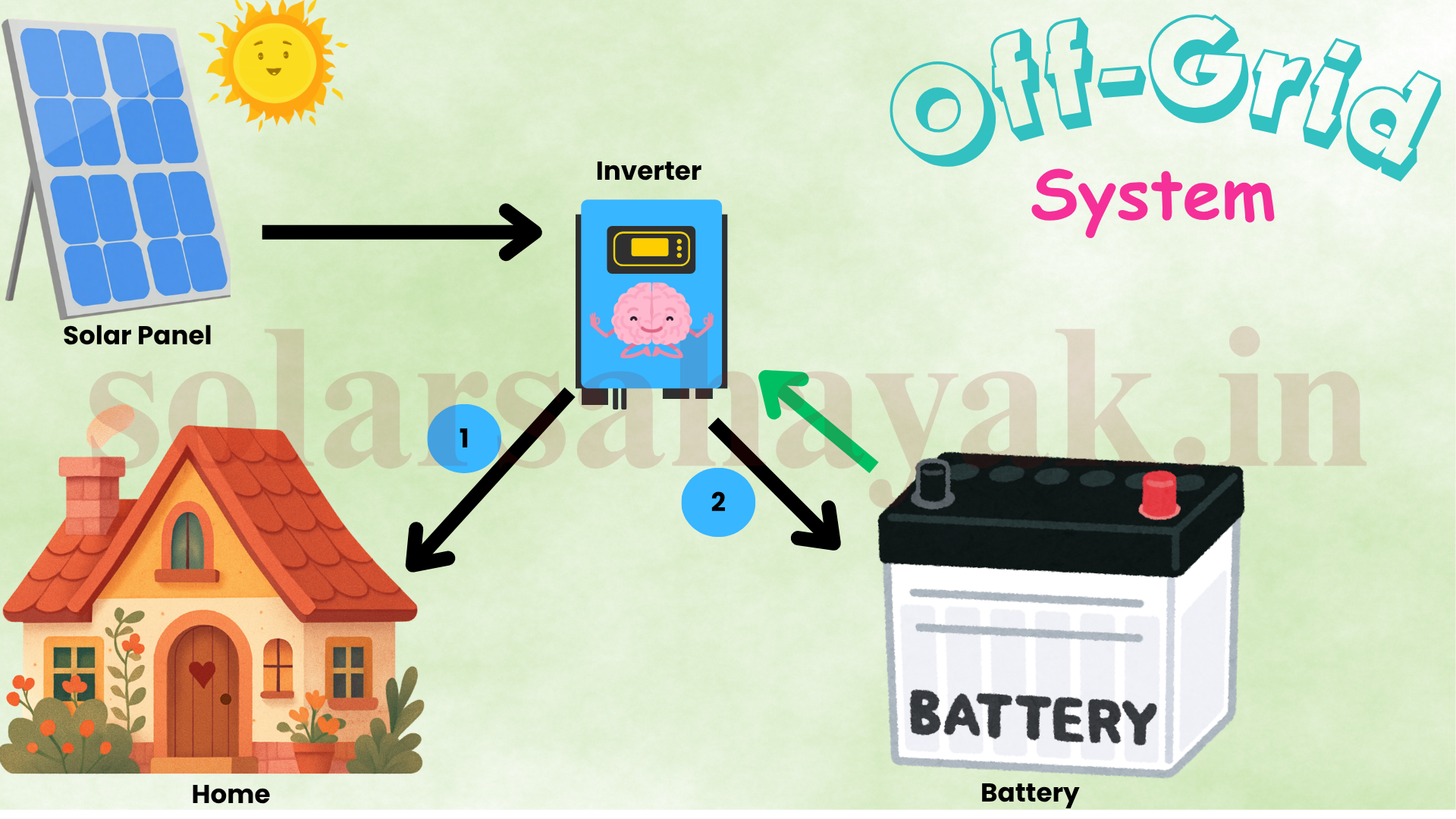
Uploaded Off-Grid solar system diagram

Off-Grid Solar

Off-Grid Solar

Note: For any type of Solar System whether On-Grid/Off-Grid/Hybrid the panels used are same. The difference only lies in their inverter types.

What is an Off-Grid Inverter?

An Off-Grid Inverter is like a self-sufficient mini power station for your home or business.

It works completely independently from the government electricity grid (UPPCL/PuVVNL). It is designed for places where there is no grid connection or where you want full independence from the grid.

Think of it as the brain and heart of an off-grid solar system.

Simple Working Principle (Step by Step)

Here’s how an Off-Grid Inverter works in easy language:

  1. Solar Panels Generate DC Power Sunlight hits the solar panels and produces DC (Direct Current) electricity.
  2. Power Goes to the Inverter The DC power from panels first goes to a charge controller (or built-in in modern inverters), which safely charges the batteries.
  3. Battery Storage The inverter stores excess energy in batteries (usually LiFePO4). Batteries act like a big power bank.
  4. Conversion from DC to AC When you need electricity (day or night), the inverter takes DC power from either: Solar panels (during daytime), or Batteries (at night or cloudy days) It converts this DC into AC power (the type your fans, lights, fridge, machines need).
  5. Supplies Power to Your Loads The inverter continuously supplies stable AC power to your home or business — 24 hours a day, just like normal electricity.

Smart Power Management

  • During sunny days: Solar panels power your loads and charge the batteries at the same time.
  • At night or during clouds: Batteries automatically take over and supply power.
  • The inverter protects the batteries from over-charging or deep discharging.

Important Limitations:

  • Off-grid systems need large battery banks because batteries are your only backup.
  • They are more expensive than on-grid systems because of the batteries.
  • Best suited when power cuts are very frequent or there is no grid connection.
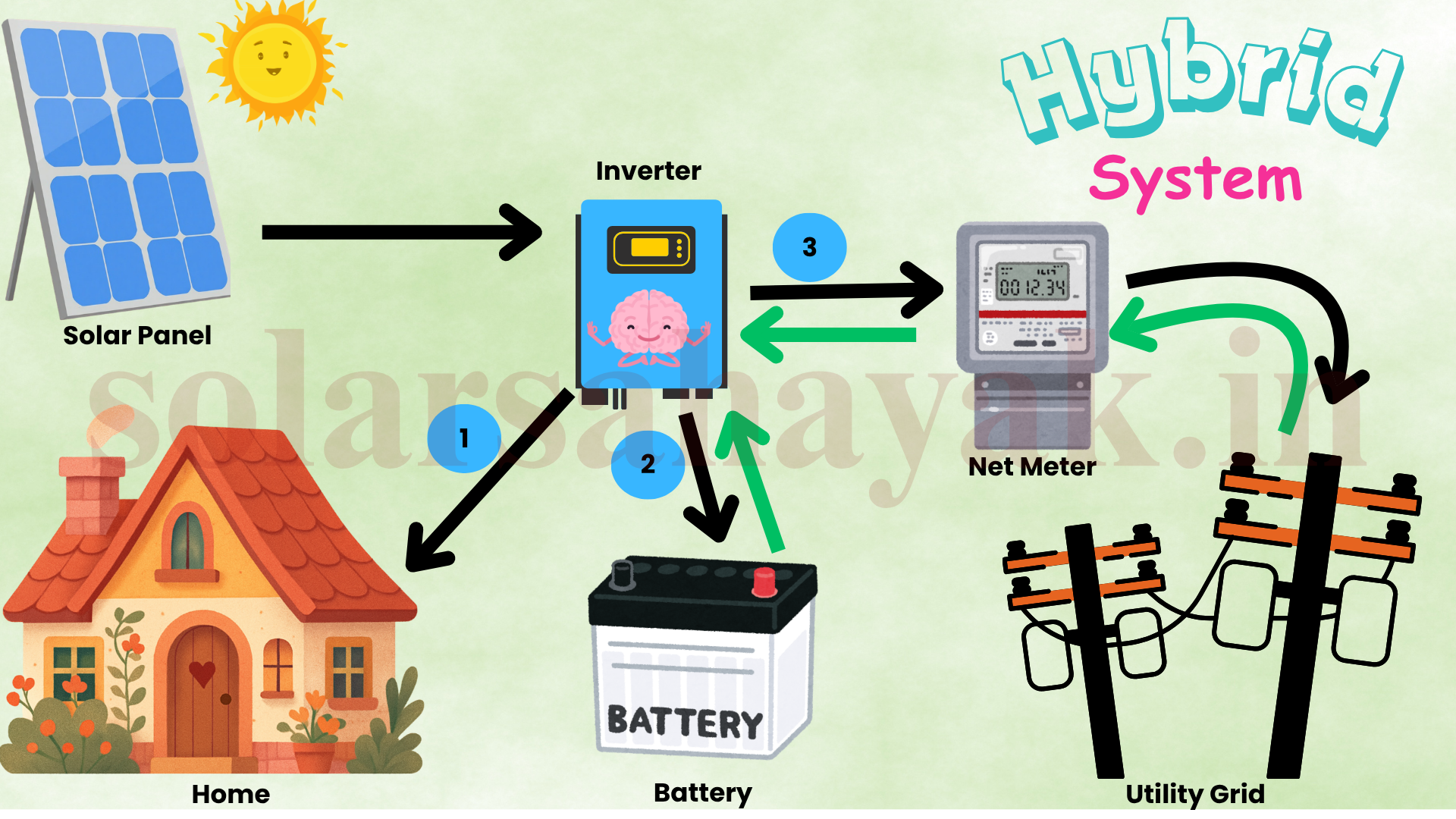
Uploaded Hybrid solar system diagram

Hybrid Solar

Hybrid Solar

Note: For any type of Solar System whether On-Grid/Off-Grid/Hybrid the panels used are same. The difference only lies in their inverter types.

What is a Hybrid Inverter?

A Hybrid Inverter is the smartest and most versatile type of solar inverter.

Think of it as an intelligent traffic policeman that can manage power from three different sources at the same time:

  • Solar Panels
  • Batteries
  • Government Grid (UPPCL / PuVVNL)

It is the best choice for most people in Uttar Pradesh because power cuts are common, but the grid is still available most of the time.

Simple Working Principle (Step by Step)

Here’s how a Hybrid Inverter works in very easy language:

  1. Solar Panels Produce DC Power Sunlight hits the panels → generates DC electricity.
  2. Hybrid Inverter Receives Power The inverter converts DC into AC power (usable electricity).
  3. Smart Priority System (This is the “magic” part) The hybrid inverter automatically decides where the power should go using this smart order:
  • Priority 1: First, it powers your home or business loads (lights, fans, AC, machines, fridge, etc.).
  • Priority 2: Extra solar power charges the batteries.
  • Priority 3: Any remaining extra power is sent to the government grid (you get credit through net metering).

During Daytime Power Cut (Grid Off)

The inverter instantly senses the grid is gone.

It switches to Island Mode (works independently).

It continues to supply power using solar + battery without any interruption.

This is the biggest advantage over a normal On-Grid inverter.

At Night or Cloudy Days

Solar power is low or zero.

The inverter automatically takes power from the batteries to run your loads.

If batteries get low, it can switch back to the grid (when grid returns).

Monitoring You can see everything on your mobile app — how much solar is generating, battery level, grid import/export, etc.

Quick Summary – Why Hybrid Inverter is Best?

  • Works with Solar + Battery + Grid
  • Gives backup during power cuts (unlike On-Grid)
  • Does not require very large batteries (unlike Off-Grid)
  • Allows net metering to earn credits

Need help choosing?

Get the Right Solar System for Your Property

Book your free consultation and get a customized solar recommendation.

Get Free Quote Now